Blog · Reviews
5 TrustMRR Alternatives for Verified Startup Revenue (2026)
By Flocksy
September 6, 2026 · 6 min read

TrustMRR made a simple bet and it paid off: pull revenue straight from a payment provider over a read-only connection, and nobody has to trust a screenshot again. It grew into a database of verified startup revenues with an acquisition marketplace attached - its own homepage says 200K monthly visitors browse SaaS, mobile apps and digital businesses for sale there.
But a marketplace is not what every founder wants. Some people want their numbers verified without a FOR SALE tag sitting next to their name. Some want the story behind the numbers, not just a row on a leaderboard. Some bill in a currency or a provider the big platforms do not handle. Whatever the reason, the verified-revenue space has filled in fast, and there are now credible alternatives doing the job in different ways.
We looked at the closest ones. Here is the honest breakdown.
1. Thonest - the alternative we would actually send a friend to
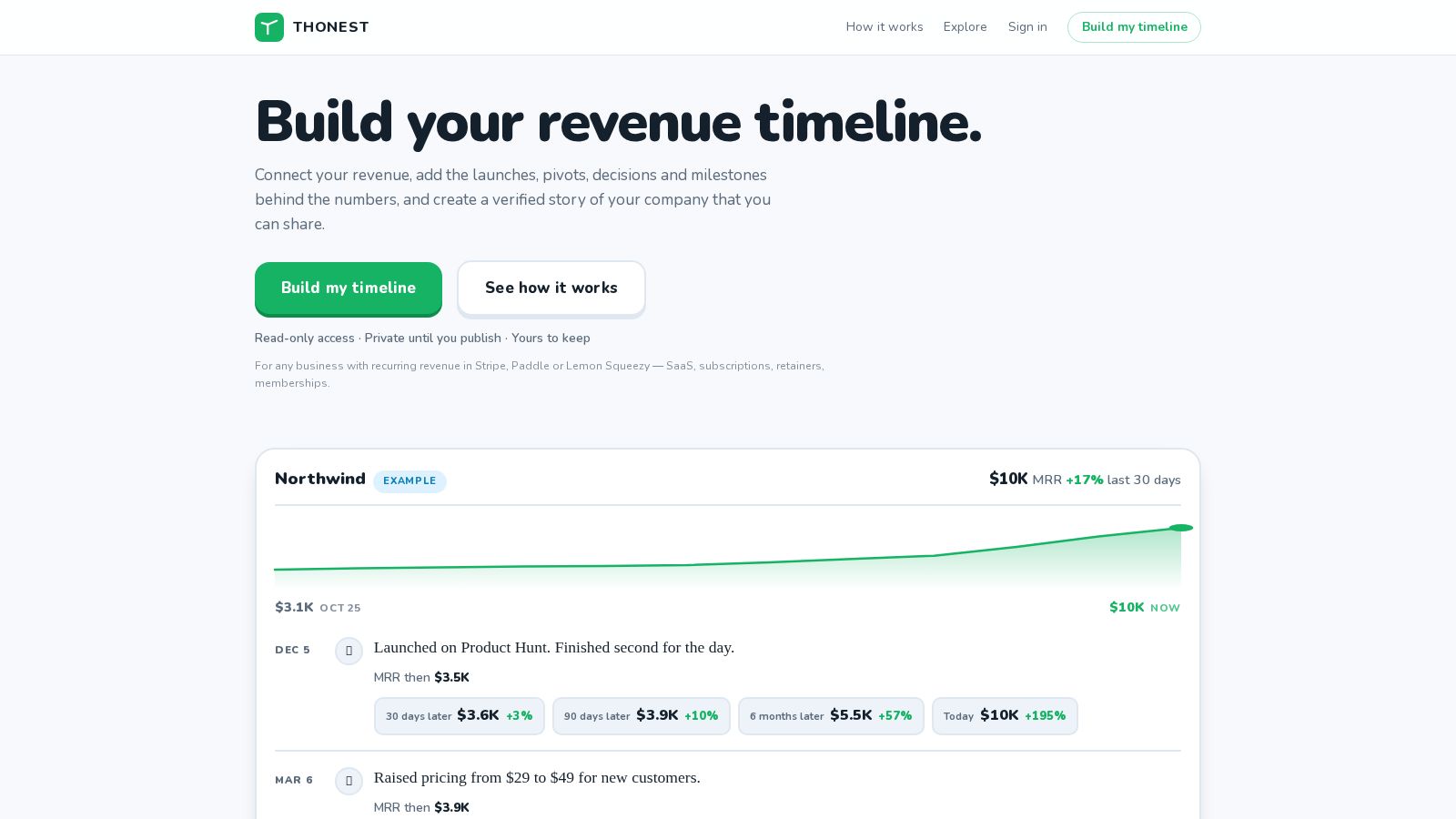
Thonest does the verification part the same way TrustMRR does - read-only connection to your billing provider, numbers pulled from the source rather than typed by you. It connects to Stripe, Paddle and the rest, and the moment the connection goes through it builds a full timeline of your revenue from the start. Not the last twelve months. The whole history the billing account can explain, laid out in one place the second you connect. From there it does something none of the others attempt: it turns those numbers into a timeline you can explain and shape yourself.
The difference is context. On Thonest you add the handful of sentences behind the shape of your revenue - a launch, a pricing change, a new hire - and each one is shown with the verified MRR and customer count on the day it happened, then 30 days later, 90 days later, six months later and today. A milestone detector reads the history and dates the moments nobody remembered to log: first $5K, revenue doubled, the lowest month, the point where growth turned. You pick which ones appear on your page.
Then there is the part nobody else does. You can hide the stretches of the timeline you would rather not show - a flat month, a dip, a season that does not help the story - and you can add the things the billing account has no way of knowing about: a pivot, a cofounder leaving, a feature that changed who bought. The numbers never move, because they are read from the source, but the shape of the story is yours. No other tool on this list gives you both.
The reasons it tops this list:
- The counting rules are published before you connect. Every company on Thonest is measured under one versioned definition, thonest.mrr.v1, written in plain English on a public page. Trials do not count. Annual plans are spread across twelve months. Discounts apply, tax is excluded, one-off charges are out. Nobody else in this space publishes their methodology this clearly.
- It refuses to fudge. Accounts billing in more than one currency are turned away rather than converted at a rate chosen after the fact. That is the kind of restraint that makes the verified label mean something.
- It is honest about causation. The product shows what happened before and after an event and says outright it cannot prove the event caused the change. Every other tool in this list quietly implies the opposite.
- The output is something you would actually send someone. A public page for investors, customers or hires, plus a one-line embed that keeps your own about page current as revenue moves. No quarterly screenshot ritual.
- No marketplace gravity. Your page is yours. You are not listed next to a price multiple or a buyer's inquiry form unless that is what you want.
The trade-offs are real: Thonest only understands recurring revenue in Stripe, Paddle and the rest, the timeline goes back as far as the billing account does, and the public directory is still thin. We wrote a full hands-on review if you want the detail. For a subscription business that talks about its numbers in public, this is the strongest option on the list.
2. VerifyMRR
VerifyMRR's pitch is security-first: verification happens over OAuth, so you never hand over a raw API key. It supports Stripe, Paddle, Shopify and Polar, and wraps the result in what it calls a Trust Score - a single tamper-proof dashboard founders can point investors, buyers and partners at instead of shipping screenshots around.
The OAuth-only approach is genuinely the right call, and the Trust Score framing is aimed squarely at due diligence conversations. The catch is maturity: this is a young product with a small public footprint, so you are betting on a newer team keeping the verification credible. Worth watching, and worth a look if OAuth-only access is a hard requirement for you.
3. ProveMyRevenue
ProveMyRevenue is the simplest tool here, and proudly so. Connect Stripe over OAuth 2.0 with read-only access, get a verified MRR figure on a shareable public page, and the number updates in real time as the business moves. It is free, with no credit card required, and the whole setup takes about a minute.
That simplicity is both the appeal and the ceiling. It is Stripe-only, the output is a single headline number rather than a history, and there is no equivalent of Thonest's published counting rules or VerifyMRR's trust scoring. If all you need is "here is my real MRR, checkable by anyone" at zero cost, it does exactly that. If you need history, context or a provider other than Stripe, look elsewhere on this list.
4. KnowMRR
KnowMRR is the closest in spirit to TrustMRR itself: connect your payment provider, get verified, and appear on a public, real-time leaderboard of companies ranked by verified MRR. It promises connection in seconds, read-only access, and it mixes leaderboard entries with acquisition-style listings, so the marketplace flavor is there too.
The leaderboard mechanic is the draw - if you want your company ranked publicly against others by verified revenue, this is the most direct alternative to TrustMRR's leaderboard. The trade-off is depth: public documentation on exactly how the numbers are counted is thin, and a leaderboard answers "how big" without answering "how did it get there." Good for visibility, thinner for telling your story.
5. OpenRevenue
OpenRevenue is the outlier: an open-source, MIT-licensed alternative you can self-host. It positions itself around cryptographic verification of revenue rather than trust in a central platform, which will appeal to exactly the kind of founder who reads code before connecting a billing account.
The obvious upside is control - your data lives on your own infrastructure and the verification logic is auditable. The equally obvious cost is that you are now running software: hosting, updates and the credibility that comes from a known third party are all on you. A self-hosted verification badge carries less weight with a stranger than a recognized platform does, which is the whole problem these tools exist to solve. For developers who want to own the stack, though, it is the only option here that offers that.
How to choose
It comes down to what you want the verified number for.
- Want the numbers and the story behind them, a timeline you can shape, with published measurement rules and nothing for sale? Thonest.
- Want OAuth-only verification aimed at investor due diligence? VerifyMRR.
- Want a free, real-time verified MRR badge and you are on Stripe? ProveMyRevenue.
- Want to be publicly ranked on a verified leaderboard? KnowMRR, or TrustMRR itself.
- Want to self-host the whole thing and audit the code? OpenRevenue.
Summary
TrustMRR deserves real credit for normalizing verified revenue - read-only connections and hourly-refreshed numbers beat screenshot culture by a mile, and its marketplace is the biggest venue in the space. But verification is becoming table stakes, and the interesting question is what a tool does with the number once it has it. Thonest's answer - a timeline that runs from the beginning, the parts you can hide and the parts you can add, published counting rules, the events and milestones that explain the shape, and a page you would be proud to send an investor - is the most complete answer we have seen. That is why it sits at the top of this list.
From the studio
Want this done for you?
One dedicated team. 140+ creative services. Real humans doing the work.